Companies that thrive over time are not always the largest, nor those that attract immediate attention, nor even those that develop technically superior solutions.
They are the ones that recognize when their business model no longer responds to the needs of the customer, the market, or their own capabilities—and act thoughtfully to reconfigure it.
This transformation is not a cosmetic change or a minor adjustment. It is a conscious rewrite of how your company creates, delivers, and captures value, in response to clear signals that emerge over time.
This article is a practical guide to identifying those signals, interpreting them correctly, and knowing when, how, and why your business model must evolve.
1. When financial results stop growing logically
A model that generates consistent revenue but no growth is also sending a warning signal.
What should you observe?
📉 A. Slowing revenue growth
If sales grow by increasingly smaller percentages despite maintaining the same levels of investment or expansion, it is a sign that the target market is saturated, has changed, or no longer perceives value in the current proposition.
📊 B. Costs growing faster than revenues
When each new customer becomes more expensive to acquire or serve, your model may be broken at its operational core. This happens, for example, when you cannot scale without proportionally multiplying your support, logistics, or customer service structure.
📌 C. Eroding profitability
Even a high-volume business can be fragile if profitability per unit steadily declines. If each new sale contributes less margin, your model is losing efficiency.
In these cases, transformation becomes a necessity to sustain the business in the long term.
2. When the human signals of the market change
Markets are not static.
Preferences, priorities, and purchasing patterns evolve over time. Therefore, your model must respond accordingly.
🕰️ A. Engagement with your brand cools off
If you notice a decline in purchase frequency, reduced engagement across your channels (website, social media, physical stores), or leads that no longer convert as they used to, your offer may be losing relevance.
This is a signal of disconnection from the current or potential customer.
📦 B. The market expects different things
A business can function perfectly until the customer context changes faster than the model itself.
For example:
Customers who once valued price now seek personalization.
Customers who valued functionality now seek experiences.
Buying behaviors shift toward digital while your model remains anchored in physical channels—or vice versa.
This misalignment requires a review of the model to bring it back in line with the market’s real expectations.

3. When technology introduces new rules of the game
Technological innovation transforms industries incrementally or disruptively. If your model depends on tools or processes that are becoming obsolete, the risk is far from minor.
⚙️ A. Automation is available, but not integrated
If your competitors use automation in key processes (customer service, logistics, marketing, dynamic pricing) and you do not, you are losing efficiency and relevance.
Transformation may involve adopting new technologies or rethinking processes to take advantage of what technology enables today.
💡 B. Your systems do not allow you to scale
When internal systems cannot support growth (rigid ERP, lack of channel integration, no advanced analytics), each new customer generates more work, not more value.
This is a symptom of a transactional model rather than a scalable one.
4. When competition is no longer playing in your space
The competitive market is alive. If new players—more agile or with different value propositions—are capturing customers that used to be yours, this is a strong indicator:
🎯 A. More agile propositions push you aside
If competitors with fewer resources capture segments of your market through focused, specialized, or better-communicated propositions, it says something about the value perception your model creates.
📉 B. Customers migrate to other experiences
If your customers leave your brand for experiences that are more coherent, faster, or offer better benefits, your model has incentivized churn instead of retention.
5. When it becomes difficult to define what makes you unique
A company with a strong model immediately understands its competitive advantage and why customers choose it. When that clarity fades, the model loses strategic strength.
Signs of lost differentiation:
You struggle to articulate what makes you different from your competitors.
Your value proposition sounds the same as everyone else’s.
Your basic decisions (pricing, product, service) are dictated by what others do, not by what you stand for.
This happens because the model stops being focused on a specific customer need and starts competing solely on price or channel saturation.
6. When the channels that sustained your growth stop working
A business model depends on sales, communication, and distribution channels that function efficiently. If those channels lose effectiveness, the business stops responding.
How can you tell?
A. Expensive channels with low return
If investing in acquiring new customers through social media, marketplaces, or physical stores no longer generates returns, it is time to rethink the channel structure.
B. Disconnection between channels
If the customer experience is fragmented across channels, it affects perception and reduces loyalty.
Omnichannel—understood as a seamless experience—is part of today’s competitiveness.
7. When your model depends excessively on a single variable
Some models appear solid until they rely too heavily on one thing:
One large client represents 40% of your revenue.
One key person (the founder) is the only one who knows how to make operational decisions.
A single product line accounts for most of your sales.
This type of dependency creates structural risk. When that factor fails, the business becomes unbalanced.
A resilient model diversifies value instead of concentrating it in a single vulnerable point.
8. When your decisions are tactical rather than strategic
A business that operates with a reactive mindset—solving urgent problems without thinking long term—is showing that its model is no longer sustainable.
You can detect this when:
Leadership meetings focus on putting out fires, not on designing the future.
Operational decisions dominate over growth decisions.
There are no clear metrics aligning strategy with execution.
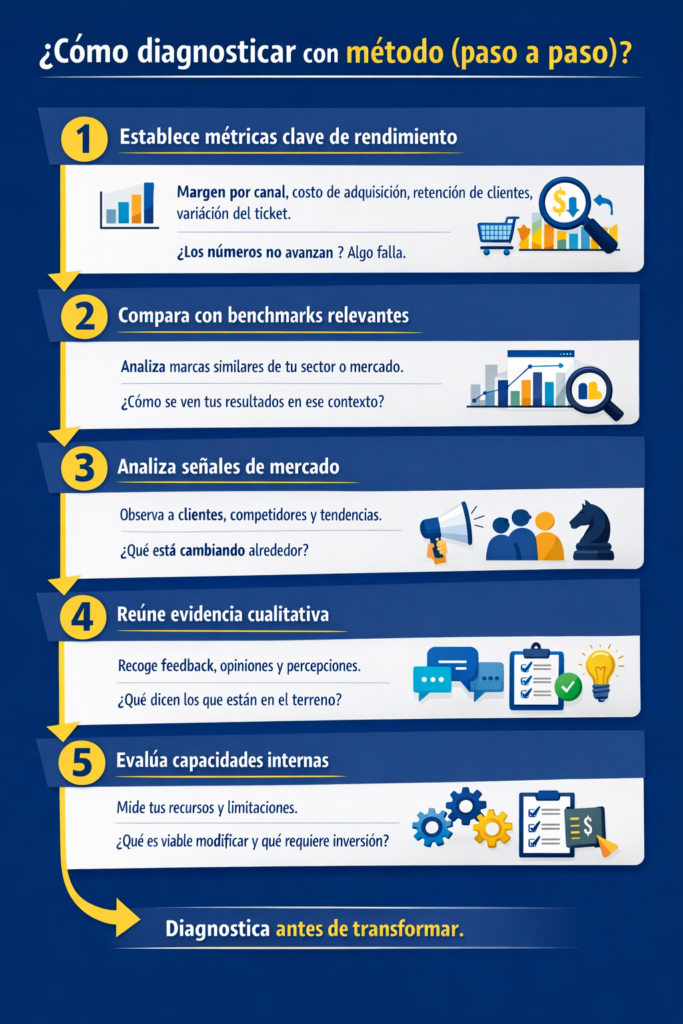
How to diagnose methodically (step by step)
Identifying that your model needs transformation is the first step. What follows is the work of diagnosing how and to what extent. Here is a process that works:
1️⃣ Establish key performance metrics
Beyond revenue, you should include: margin by channel, acquisition cost, customer retention, purchase frequency, and average ticket variation.
A decline or stagnation in these metrics—without a clear seasonal or external reason—indicates that the model is not responding.
2️⃣ Compare against relevant benchmarks
You do not need to compare yourself with global giants. Look for brands in your sector, size, or growth stage to understand what performance is expected in your market.
3️⃣ Analyze market signals
What are your customers, competitors, and partners doing? Changes in purchasing behavior, the emergence of new players, or new channels should influence your diagnosis.
4️⃣ Gather qualitative evidence
Hard data matters, but so do insights: customer feedback, conversations with distributors, and the perceptions of sales teams.
5️⃣ Evaluate internal capabilities
It is not just about what you need to change, but also about what you can change with your current resources and what requires structural investment.
Transformation is a strategic decision
Knowing that your business model needs to transform is not a matter of trends or wishful thinking. It is a conclusion based on signals that come from both numbers and strategic intuition.
A well-planned transformation allows you to:
Maintain and expand relevance in changing markets
Align your offering with real customer expectations
Create sustainable competitive advantages
Increase resilience in the face of external shocks
The decision to update your model is a moment of clarity rather than change itself. It is not executed by decree. It is built through diagnosis, evidence, vision, and discipline.
Do you want to review your current business model and understand whether it needs trans